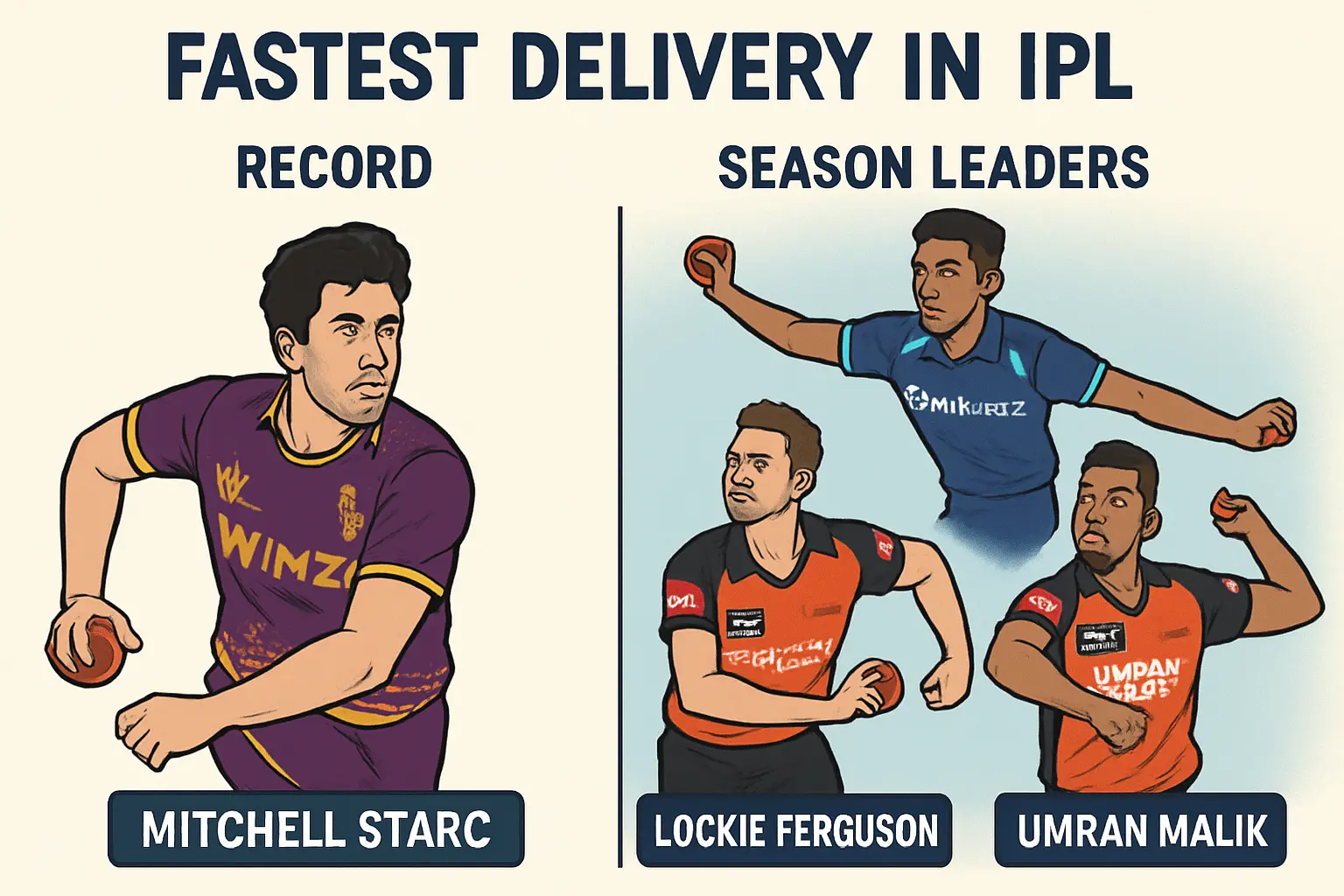
Record at a glance: Shaun Tait holds the fastest delivery in IPL history with 157.7 km/h (98.0 mph). Latest season leader: Mayank Yadav topped the speed charts with 156.7 km/h (97.4 mph).
The Indian Premier League has always had room for poetry and chaos. On one side, deft wrists and late swing. On the other, raw pace that hisses, cuts the air, and smashes into the keeper’s gloves with a crack you can hear from the third tier. The fastest delivery in IPL isn’t just a statistic; it’s a barometer of where the league sits in the global speed race, a reflection of how teams recruit, how bowlers prepare, and how the game keeps evolving under pressure lights and heaving crowds.
A crisp answer sits at the top: the all-time IPL record belongs to Shaun Tait, clocked at 157.7 km/h. That remains the benchmark for the quickest ball in the tournament’s history. In the most recent completed season, the speed spotlight was grabbed by LSG’s Mayank Yadav with a 156.7 km/h laser—unmistakable proof that Indian pace isn’t just coming; it has arrived.
What follows is a definitive, expert-led guide to the fastest ball in IPL context: the record, the top 10, the leaders by recent seasons, how speed is measured, what influences numbers, and why some deliveries and venues seem to produce separate kinds of thunder.
Top 10 fastest deliveries in IPL history
Note on methodology: This list consolidates official broadcast radar/Hawk-Eye numbers and match reports from trusted outlets. Speeds are shown in km/h with mph conversions in parentheses for clarity.
- Shaun Tait (RR) — 157.7 km/h (98.0 mph)
- Lockie Ferguson (GT) — 157.3 km/h (97.7 mph)
- Umran Malik (SRH) — 157.0 km/h (97.6 mph)
- Mayank Yadav (LSG) — 156.7 km/h (97.4 mph)
- Anrich Nortje (DC) — 156.2 km/h (97.1 mph)
- Dale Steyn (SRH) — 154.4 km/h (95.9 mph)
- Kagiso Rabada (DC) — 154.2 km/h (95.8 mph)
- Jofra Archer (RR/MI) — 153.9 km/h (95.6 mph)
- Mitchell Starc (RCB/KKR) — 153.6 km/h (95.4 mph)
- Pat Cummins (KKR/SRH) — 153.5 km/h (95.3 mph)
A list like this hides as much as it reveals. The spread between first and fifth is barely a kilometer per hour or two—margins so thin that temperature, a tailwind in a wide-open stadium, or micro-variations in release point can nudge numbers up or down. Yet patterns tell a story: speed merchants come from across the world, but the last few seasons have seen Indian pace—Umran Malik, Mayank Yadav—nudging into the absolute elite bracket.
Latest-season pace picture
The latest completed IPL season delivered a clear takeaway: hostile pace still changes games, especially when it arrives early and hits lengths on the hard side of a good length. Mayank Yadav, bowling with a seamless rhythm and a distinctly late wrist snap, topped the season’s radar at 156.7 km/h. His short window of action transformed LSG’s middle-overs threat, because batters spent overs waiting for the next missile, often losing shape on slower balls that followed.
A recurring pattern in modern IPL seasons:
- One or two marquee speedsters hit 155+ km/h, often during powerplay overs when adrenaline and new-ball grip are at peak.
- A broader pack operates in the 150–153 km/h band, with the likes of Anrich Nortje, Lockie Ferguson, and Kagiso Rabada capable of sustained bursts.
- Tactical pace-off variations from the same quicks make their hostility more effective; speed alone no longer earns wickets unless married to sharp lines and platformed by a coherent plan.
Fastest deliveries by season (recent snapshot)
Keeping to a recent window offers the most relevant picture of current speed capabilities and trends. Seasons are labeled by competition order rather than calendar.
- Season 13 — Anrich Nortje (DC) led with a 156.2 km/h rocket, part of a blistering spell that cemented a pace template for DC: hard lengths, stumps targeted, and sustained hostility through over two and over three of spells.
- Season 14 — The top end sat in the low 150s, with Lockie Ferguson’s spells for KKR often topping the nightly radar. A season notable for depth of speed across teams rather than a single headline number.
- Season 15 — Lockie Ferguson produced a 157.3 km/h thunderbolt, with Umran Malik posting 157.0 km/h and logging a season of repeat 150+ bursts. The season belonged to raw pace as a storyline.
- Season 16 — The ceiling hovered a touch lower relative to Season 15, with top outputs clustering around the 153–154 band. Sustained heat from Nortje and Archer when available, with Alzarri Joseph and others contributing bursts.
- Season 17 — Mayank Yadav took the speed crown at 156.7 km/h, and did so with remarkable control through multiple spells, arguably the biggest storyline for Indian domestic pace in an IPL campaign.
A longer archive would include many seasons where the ceiling sat in the 152–154 band, a reminder that conditions, ball specifications, and personnel availability (injury management is a constant theme for high-pace bowlers) play real roles in shaping the final radar peaks.
Fastest by player: profiles, mechanics, and tactical notes
Shaun Tait
Signature: A slingshot action, open-chested alignment, heavy shoulder rotation, and wrist flexion that helped the ball scream out at release.
Why the number popped: Tait hit his rhythm early in spells. When his front leg braced cleanly and the arm path stayed direct, the ball flew. In IPL conditions, the lacquered white ball and dry evenings were perfect for his skid-through style. The record number at 157.7 km/h reflects peak kinetic chain transfer and the kind of freedom that comes only when a bowler’s mind is still and the body is tuned for sprint cycles.
Lockie Ferguson
Signature: Athletic run-up, terrific hip-shoulder separation, and late-arm acceleration. Ferguson’s forearm speed and minimal deceleration post-bound made the ball feel measurably heavier.
Tactical edge: A rare quick who can shift between a 150+ heavy length and a cross-seam that still hurries batters. High pace at the death works for him because he isn’t hunting the base of off-stump with every ball; he changes lane profiles, forcing toe-end contacts on large grounds.
IPL note: The 157.3 number didn’t arrive in isolation; his body of work shows a bowler who can peak late in spells, which is unusual. Most quicks lose speed after the first over; Ferguson can build if the rhythm clicks.
Umran Malik
Signature: Whippy arm path, pronounced shoulder rotation, and a slightly delayed release that means the ball arrives a fraction later than batters expect, paradoxically feeling quicker.
Development arc: Early spells sprayed the ball; then came a period where SRH used him in one-over bursts to maximize speed and minimize exposure. The 157.0 km/h number famously arrived in a season when he strung together multiple 150-plus overs across weeks.
Tactical growth: The difference-maker for Umran will always be control at high speed. When he lands the hard length, he’s unplayable on two-paced surfaces. When he misses his base, momentum slips quickly in T20.
Mayank Yadav
Signature: Almost elastic action; he gathers quietly and explodes late. The standout is how clean the energy transfer looks—no visible strain, yet the readings hit 156.7 km/h.
Tactical footprint: His team unlocked him as a phase disruptor in the middle overs. The effect was psychological as much as tactical: batters set deeper and started committing earlier to shots, making them vulnerable to the change-up a ball later.
Future lens: Repeatability will decide whether he turns speed into a long career. Early signs show a compact base and a front-leg brace that bodes well for durability.
Anrich Nortje
Signature: Tall, side-on efficiency with a braced front leg that loads the kinetic chain like a catapult. The seam stays upright longer than most at that pace.
Spell craft: Few have bowled faster overall overs in the IPL. His celebrated bursts for DC produced sequences where every ball felt north of 150 and the top end reached 156.2. He targets the top of off, not just the toes, which makes edged dismissals likelier on quick decks.
Tactical note: In powerplays, he often goes cross-seam only when the ball is older. The foundation remains seam-up with eyes on the fourth stump—old-school Test principles at T20 speed.
Dale Steyn
Signature: Seam position that could have graced a textbook, plus a violent last step that snapped energy into the ball without losing rhythm.
IPL footprint: Even in seasons where the numbers didn’t breach 155, Steyn created a perception of speed that was almost as valuable. He hurried batters without needing to live constantly in the red zone, and in the IPL’s early and middle years he set the standard for pace with control.
Kagiso Rabada
Signature: Powerful hip drive and a braced front-leg stop that catapulted the upper body over the front side. At his best in the IPL, he hit 154+ with late dip.
Uses in T20: Wider yorkers at 145–150, surprise hard length at 150+, and a bouncer that doesn’t need to be top-end fast to be effective because of his heavy cross-seam option.
Jofra Archer
Signature: Effortless speed. The ball leaves before you register the point of release. The easy run-up hides late-arm whip and remarkable shoulder flexibility.
IPL tactical note: When fit, he maintains speed deeper into spells than most, allowing teams to keep him for two overs at the back without fearing a 7–8 km/h drop.
Mitchell Starc
Signature: Left-arm angle with late inswing, making his 150+ yorker the most dangerous single ball in T20 when landing. In the IPL, his top speeds came early in spells with the new ball tail.
Death overs role: His angle plus speed can suffocate even on flat tracks, provided the margin for error remains small enough to avoid slotballs.
Pat Cummins
Signature: Strong lines, classical repeatability, and a bouncer that hurries because of a late snap at release. His quickest balls in the IPL came in spells where he pinned back-of-a-length into the hip line and then jumped fuller for surprise.
Jasprit Bumrah (contextual speed)
Signature: Unorthodox gather, short delivery stride, burst of speed off the final step. Bumrah’s fastest IPL deliveries have flirted with the low 150s, but his killing glass-blade is accuracy. Even when the gun reads 145–148, the ball feels heavy and late.
Fastest by team: speed traditions and recruitment patterns
- SRH: A consistent home for quicks. The franchise’s identity has leaned into pace through multiple cycles—Steyn, Bhuvneshwar as leader and stabilizer, followed by raw heat in Umran Malik. The balance of swing, seam, and aggression keeps SRH competitive on two-paced pitches.
- DC: A modern pace hub. Nortje’s peak spells have shaped how DC uses the powerplay: one over of hostility early, then another targeted strike just before strategic timeout to punch holes in batting plans.
- KKR: Ferguson and Cummins brought two distinct speeds—one heavy and skiddy, the other heavy and climbing. KKR often pairs pace with mystery spin, letting speed intimidate while spin harvests errors.
- MI: A factory of controlled pace. Archer when available, Bumrah as fulcrum. Their culture values speed but only in service of a system that wins the important overs.
- RR: The Tait chapter remains etched in memory. In later seasons, their speed arsenal prioritizes rhythm and accuracy, but they’ve never lost love for a speed burst that can tilt a chase.
- RCB: Periods of high-end pace through Starc and others, often paired with bounce from tall quicks. On batting-friendly home surfaces, RCB’s pace value is as much about intimidation as wicket-taking.
- PBKS: A team that oscillates between out-and-out speed options and swing-bowling cores. When they go pace-heavy, they look to sustain heat through overs five to eight.
- CSK: Less reliant on pure pace peaks, more on relentlessly good lengths. Yet, when they do carry a bowler who can touch 150, the change-up within their control-first template is devastating.
- GT: Lockie’s 157.3 number sits at the heart of the club’s early identity: a franchise that embraces data-led tactics and isn’t shy of unleashing late-innings pace.
- LSG: Mayank Yadav’s arrival reframed expectations. They moved from seeking mere phase control to setting traps built around sudden extreme speed.
Fastest by venue: how surfaces, air, and geometry interact
- Wankhede Stadium, Mumbai: Even bounce, sea breeze, and a true surface combine to let genuine pace show. Speeds aren’t necessarily higher because of air; what improves is repeatable rhythm. Bowlers run in with confidence, which keeps technique clean and the ball coming out hot.
- M. Chinnaswamy Stadium, Bengaluru: The air sits a touch thinner and the square is flat. Speed guns measure near release, so air density doesn’t change the reading, but the confidence of quicks does. Bowlers are willing to go all-in on hard length because carry is excellent.
- Eden Gardens, Kolkata: Historically a truer surface under lights with a generous outfield. Long channels on the good length help speed appear exaggerated because batters can’t judge lift early.
- Narendra Modi Stadium, Ahmedabad: Large boundaries and, on some nights, spicy carry. The setting favors speed when curators leave a hint of green sheen. The abrasion later can add reverse swing to the package.
- MA Chidambaram Stadium, Chennai: Not a fast bowler’s cliché paradise, yet when there’s a bit of early sweat in the surface, quicks who pound a back-of-a-length can get the ball climbing at the chest. Pace here supports wicket-to-wicket accuracy rather than raw bouncer warfare.
- DY Patil, Brabourne, and other coastal venues: Early evening humidity can add zip off the deck. The white ball, when new, tends to kiss and carry, making the first over the best bet for touching a personal top.
How bowling speed is measured in the IPL
- Radar gun (Doppler): A high-frequency signal reflects off the moving ball to compute speed. Broadcast speed typically refers to the ball’s velocity at or just after release, which is the highest point. The number will always be higher than speed after bounce, because the turf, seam friction, and air drag reduce velocity.
- Hawk-Eye/tracking: A multi-camera system reconstructs the ball’s flight path, projecting speed at distinct frames. Some broadcasts display instantaneous speed at release, others display a calibrated estimate. Minor variances between stadium setups and calibrations can explain small discrepancies you see between different sources.
- km/h vs mph: Indian broadcasts favor km/h. For quick mental math, multiply mph by 1.609 to reach km/h; multiply km/h by 0.6214 to reach mph. A quick reference: 150 km/h is about 93.2 mph; 155 is around 96.3 mph; 160 is almost exactly 99.4 mph.
- Why numbers vary: Wind direction, temperature, and humidity don’t change the measured release speed but can influence how bowlers deliver the ball—tension vs freedom alters technique, which moves the needle. Camera angles and radar placement also contribute to small reading differences, especially on marginal calls around the 150 mark.
The anatomy of elite speed in the IPL
Biomechanics
- Run-up rhythm: Consistency beats raw sprint speed. A metronomic run-up ensures that the back-foot contact and front-leg brace occur in the right places relative to the crease, maximizing energy transfer.
- Front-leg brace: The single most important event at release. When the front leg “blocks” without collapsing, it converts horizontal momentum into vertical and rotational energy, amplifying ball speed.
- Hip-shoulder separation: The torque from hips opening while shoulders remain closed briefly creates a whip effect. Too early and the energy dissipates; too late and the release angle suffers.
- Arm path and forearm speed: High-velocity deliveries correlate with rapid forearm pronation and a late whip. It’s not just long levers; it’s how late they accelerate.
Training and prep
- Strength-speed balance: Modern IPL quicks train for power rather than bodybuilder strength. Trap bar jumps, resisted sprints, and posterior chain work underpin the late-season peaks.
- Micro-dosing speed: One or two overs of near-maximum intensity in practice, not five. Enough to remind the body what top-end feels like without draining the battery.
- Recovery: Ice baths are cliché; sleep, soft-tissue work, and nutrition are not. High-speed bowlers in the IPL work closely with physios to schedule hard sessions 48–72 hours before match day.
Equipment and ball behavior
- The white Kookaburra: Fresh out of the box, it’s hard and glossy. Skid through is higher. As the lacquer wears, swing fades, and reverse swing creeps in depending on surface and square sand content.
- Spikes and boots: Stable platforms with rigid plates help brace the front leg. Many quicks have moved toward mid-cut boots that stabilize the ankle without hampering dorsiflexion.
Tactics: speed used well beats speed used often
- Powerplay usage: The perfect over starts with one hard length at top speed, followed by a straighter hard length, then a fuller ball that looks like a yorker but lands in the slot just short. Speed sets up the fuller ball; smart captains align fields to harvest mishits.
- Middle-overs disruption: One over of 150+ in overs 7–10 changes a chase’s geometry. Batters who had settled for stable strike rotation may now hedge guard positions, opening the door for cross-seam cutters.
- Death overs: Pure speed at the blockhole is feast-or-famine. The very quickest mix clubs: a 150+ straight yorker, then a 142–145 slower wide yorker, then the chest-high bouncer at 147–150 to draw a top edge.
- Match-ups: Swing value is minimal once the ball is old; pace value rises if you pin a batter with a clear weakness—slower hands, late pick-up, bat coming down from too high. Teams map these traits meticulously.
Indian pace: a new ceiling
The IPL has revealed India’s speed evolution in real time. Two headlines matter: Umran Malik’s 157.0 and Mayank Yadav’s 156.7. Both stand in the rarefied air of the fastest deliveries the league has ever recorded, and both were recorded by Indian quicks. Add Navdeep Saini’s upper-152 bursts and Jasprit Bumrah’s heavy-ball deception, and you get a picture that would have been unthinkable in the league’s early chapters.
An important detail: the development ecosystem. Franchises now station high-speed cameras in training, monitor ankle eversion and tibial rotation, and use weighted ball protocols carefully. The skill is no longer discovered by accident; it’s coached, protected, and deployed wisely.
Fastest over and fastest spell: different tests, different legends
- Fastest single delivery: the headline number. A snapshot of peak output.
- Fastest over: a rarer achievement, because it requires repeating 150+ multiple times within six balls. Nortje has come closest to building a folklore around fast overs in the IPL context, stringing together sequences where every ball pressed the upper limits of the radar.
- Fastest spell: the truest test of a professional’s conditioning and technique. Body language matters—short rests between overs, field hustle, and how quickly a bowler’s breath returns. In the IPL, the smartest spells combine one blistering over with variations across the rest.
Speed vs success: the balance that wins titles
Take a quiet look at the league’s best bowling units across seasons: they rarely chase the speed metric for its own sake. What they prize is velocity at the right moment and with the right plan. The fastest ball in a game means little if it lands on a batter’s arc or if the field ignores the bait.
That said, raw pace buys forgiveness. A hard length at 150 is more likely to beat a batter who presses out of shape than the same ball at 137. It opens up fielding angles—third man up, fine leg finer—because mishits travel to catchers not gaps. It can also create wicket-maidens in a format that pretends they don’t exist.
Conversion guide: km/h to mph for cricket speeds
| km/h |
mph |
| 150 km/h |
93.2 mph |
| 152 km/h |
94.4 mph |
| 154 km/h |
95.7 mph |
| 156 km/h |
96.9 mph |
| 157 km/h |
97.6 mph |
| 158 km/h |
98.2 mph |
| 160 km/h |
99.4 mph |
If you prefer mph, multiply km/h by 0.6214; if you think in km/h, multiply mph by 1.609.
Selected 150+ km/h deliveries in IPL (illustrative, not exhaustive)
- Shaun Tait — 157.7 (RR)
- Lockie Ferguson — 157.3 (GT)
- Umran Malik — 157.0 (SRH)
- Mayank Yadav — 156.7 (LSG)
- Anrich Nortje — 156.2 (DC)
- Dale Steyn — 154.4 (SRH)
- Kagiso Rabada — 154.2 (DC)
- Jofra Archer — 153.9 (RR/MI)
- Mitchell Starc — 153.6 (RCB/KKR)
- Pat Cummins — 153.5 (KKR/SRH)
Measuring accuracy and why broadcast numbers sometimes feel “off”
- Release vs post-bounce: The big number you see is the fastest point of the ball’s journey—the instant after release. Viewers often conflate what their eyes judge off the pitch with the speed gun reading. A skiddy 146 at release may feel quicker than a 150 that rises, because the batter’s pull shot telegraphs fear or control in different ways.
- Calibration nuance: Stadiums vary, and temporary installs during itinerant phases can show slight differences. Across a season, these variances wash out, but for one-off comparisons they matter.
- Camera parallax: When highlights are clipped, the angle of the lens can make a ball look quicker or slower. Trust the numbers more than your eyes on TV angles.
Venues and conditions that help fast numbers stick
- New ball hardness: The first over offers the best chance to touch personal peak. Even if swing isn’t present, the leather hardness reduces deformation on impact and maintains speed integrity at release.
- Night conditions: Cooler evenings let bowlers last longer at high intensity; sweat management becomes easier than in a humid afternoon. Under lights, carry often improves.
- Surfaces with true bounce: The quicker the deck, the cleaner the rhythm. Bowlers commit earlier. That commitment smooths the chain through back-foot contact, front-foot plant, trunk rotation, and release.
The fastest yorker in an IPL context
Yorkers at 150+ are outliers because the fuller release angle robs a fraction of arm speed and because the fear of missing full persuades some bowlers to shade down a couple of clicks. Starc, Bumrah, and Rabada have all delivered yorkers well north of 145 with repeatability, and there are isolated balls that punch past 150. This class of delivery remains cricket’s hardest ball to play when released at chest-high arm speed with late dip and precision.
Team and captaincy impact on speed utilization
- Field settings as a signal: Slip in for the first two balls, deep point back for the third, fine leg finer for the bouncer. Captains who give visual cues let the quick focus on execution without racing through mental math between balls.
- Over allocation: The fashion now is one powerplay over, one just past the powerplay, and one late. Speed merchants need that mid-innings over to stretch their legs and rebuild peak before the death sprint.
- Bowling changes: Quick switches after a 150+ over can protect the bowler’s hamstrings and trick batters into targeting the next over wrongly. You’ll see smarter captains hold a spinner for that exact reason—they draw a slog against spin after a speed scare, and then bring the quick back when the batter’s shape is shaky.
Indian quicks: pecking order by top speed
- Umran Malik: fastest recorded Indian delivery in IPL, 157.0 km/h.
- Mayank Yadav: right on his heels at 156.7 km/h, with a control profile that excites coaches.
- Navdeep Saini: high-152 bursts with skiddy release.
- Jasprit Bumrah: peak readings in the low 150s, with consistent delivery speed in the high 140s and unmatched control.
Coaching clinics: keeping speed without breaking down
- Landing mechanics: Bowlers and coaches obsess over front-foot placement a shoe-width either side of target. If the foot closes off toward fine leg, hips can’t fully open; open too far and power bleeds out.
- Workload micro-cycles: The week builds across a pyramid—short, fast overs at the base; a single 90% day two days out; activation on match-day minus one. The goal is peaking without layering fatigue.
- Mental groove: The fastest overs often follow the quietest minds. Routines—marking the run-up, a breath at the top, a single trigger word—strip noise away. In stadiums where sound shakes the grass, this matters more than any gym metric.
Context: fastest in IPL vs international speed
The IPL’s best numbers sit just under the absolute peaks of international cricket speed tables. That gap is marginal and unsurprising; national sides in multi-format series occasionally produce rare atmospheric pockets and fresh legs. In the IPL, cluster scheduling and travel nudge workloads upward. Yet the fact that IPL numbers habitually touch 155+ confirms that the league is a genuine top-speed arena. For bowlers, sustaining peak output across a month is a purer test than a single extraordinary delivery.
A note on mph vs km/h in storytelling
Speed in cricket has always lived in two languages. In countries tuned to mph, 95 feels like a cliff; in km/h land, 150 does. The eye finds 100 mph more romantic than 160 km/h; the wristwatch mind prefers 150/155/160 stepping stones. Whichever scale you prefer, remember the weight of context: the line, the field, the batter’s decision time, and the repeatability across an over. A solitary 157 means less than a spell that sits at 150, 149, 148, 150, then 152 for the kill ball.
Answering common searches with direct clarity
- Fastest delivery in IPL history: Shaun Tait, 157.7 km/h (98.0 mph).
- Fastest delivery in the most recent completed season: Mayank Yadav, 156.7 km/h (97.4 mph).
- Fastest Indian bowler by top IPL speed: Umran Malik, 157.0 km/h (97.6 mph).
- Consistent 150+ practitioners in the IPL era: Anrich Nortje, Lockie Ferguson, Umran Malik; with bursts from Jofra Archer, Kagiso Rabada, Mitchell Starc, and Mayank Yadav.
- Average pace vs top speed: Elite IPL quicks who touch 155+ often average in the 145–149 band across spells. The day’s fastest ball typically sits 5–8 km/h above that bowler’s spell average.
- Speed gun accuracy: Broadcast numbers are reliable within small margins. Differences of a few decimals across sources reflect calibration, not fantasy.
The living list: fastest deliveries by team and venue (highlights)
By team highlights
- SRH: Steyn, Umran, Cummins (later stint), Shami—an arc from classic pace to modern heat.
- DC: Nortje and Rabada together—a nightmare pairing when the deck carries.
- KKR: Ferguson and Cummins gave them both peak single-ball speed and thudding back-of-a-length sequences.
- MI: Archer’s burst pace and Bumrah’s heavy ball; two kinds of hurry.
- LSG: Mayank’s top-speed headline and a template for controlled aggression around him.
- GT: Data-led usage of genuine pace in final overs, topped by the tournament’s second-fastest ball.
By venue highlights
- Wankhede: Reputationally the most forgiving to speed. Career-high season-average pace numbers often come here.
- Eden Gardens: Under lights, legitimate carry that makes 147 feel like 150 because batters commit earlier and the ball climbs late.
- Chinnaswamy: Exposes short lengths because of boundaries but rewards top speed when bowled into the hip and thigh channel with a leg-side trap.
- Ahmedabad: The stage for marquee speed moments—wide-open sight, large field, encouraging surfaces.
Speed’s place in the modern IPL meta
Spin, mystery or orthodox, dictates narratives across many nights, but nothing steals a crowd’s breath like a rapid spell. The best teams balance both: pace for shock and awe, spin for squeeze. The fastest delivery in an IPL match pivots plans. The batter’s back foot shuffles; the captain reaches for a different card; the analyst in the dugout tweaks the next over’s script.
And speed itself is entering a smarter age in the league. Franchises scout actions that are built to last, not just bowled hot for a fortnight. They look beyond the raw reading, hunting for bowlers whose fastest delivery arrives with a repeatable run-up, a braced front side, and a calm face at release. The result is a tournament where 150 is no longer a lottery ticket; it’s part of a professional toolkit.
Practical tracker notes for followers of the speed race
- The new ball in over one or two is your best window for a season’s top reading.
- Watch the front-leg brace: when a bowler’s knee holds firm and the torso whips over, expect a spike.
- Mid-overs bursts following a quiet powerplay can produce second-wind peaks, especially for bowlers with efficient, low-cost actions like Archer and Ferguson.
- Venue patterns matter: chase speed at Wankhede and Ahmedabad; look for intelligent hard length rather than redline speed at Chepauk.
A final word: why this record matters
The IPL’s charm lies in factions—those who love the googly after the googly, those who worship sixes, those who live for the contest at the crease. The speed race is its own mythology. The fastest ball in IPL history, Shaun Tait’s 157.7, is a north star for quicks who grew up on grainy clips and terrace dreams. The recent rise of Indian quicks to the absolute top end, with Umran Malik and Mayank Yadav ripping through the 155 barrier, is the proof of a broader truth: the league isn’t just showcasing speed; it’s creating it.
On some night under lights, in front of a full house and a sky that hums with sound, another bowler will line up from the top of their mark, the world will narrow to six stumps and one pair of gloves, and the radar will blink a number that nudges the game forward. The fastest delivery in the IPL is a moving target. That’s the point. It keeps the league honest, the batters humble, and the rest of us a little breathless.
|