
Cricket in India runs on an economy that is both straightforward and layered. At the top it looks like four contract grades and three match-fee numbers. Underneath, there’s a lattice of incentives, domestic structures, women’s parity, state retainers, allowances, and tax considerations that ultimately determine take-home pay. When you’ve sat in dressing rooms, chased selection calls across time zones, and compared notes with selectors and administrators, you learn that salary is not a single figure; it’s the sum of your calendar.
This is a comprehensive, expert look at indian cricket player salary—how team india salary is structured, how bcci player salary works, what central contracts and match fees actually mean for the men and women who wear the India shirt, and how a typical season translates into a bank statement.
Quick answer: how much do Indian cricketers earn per match
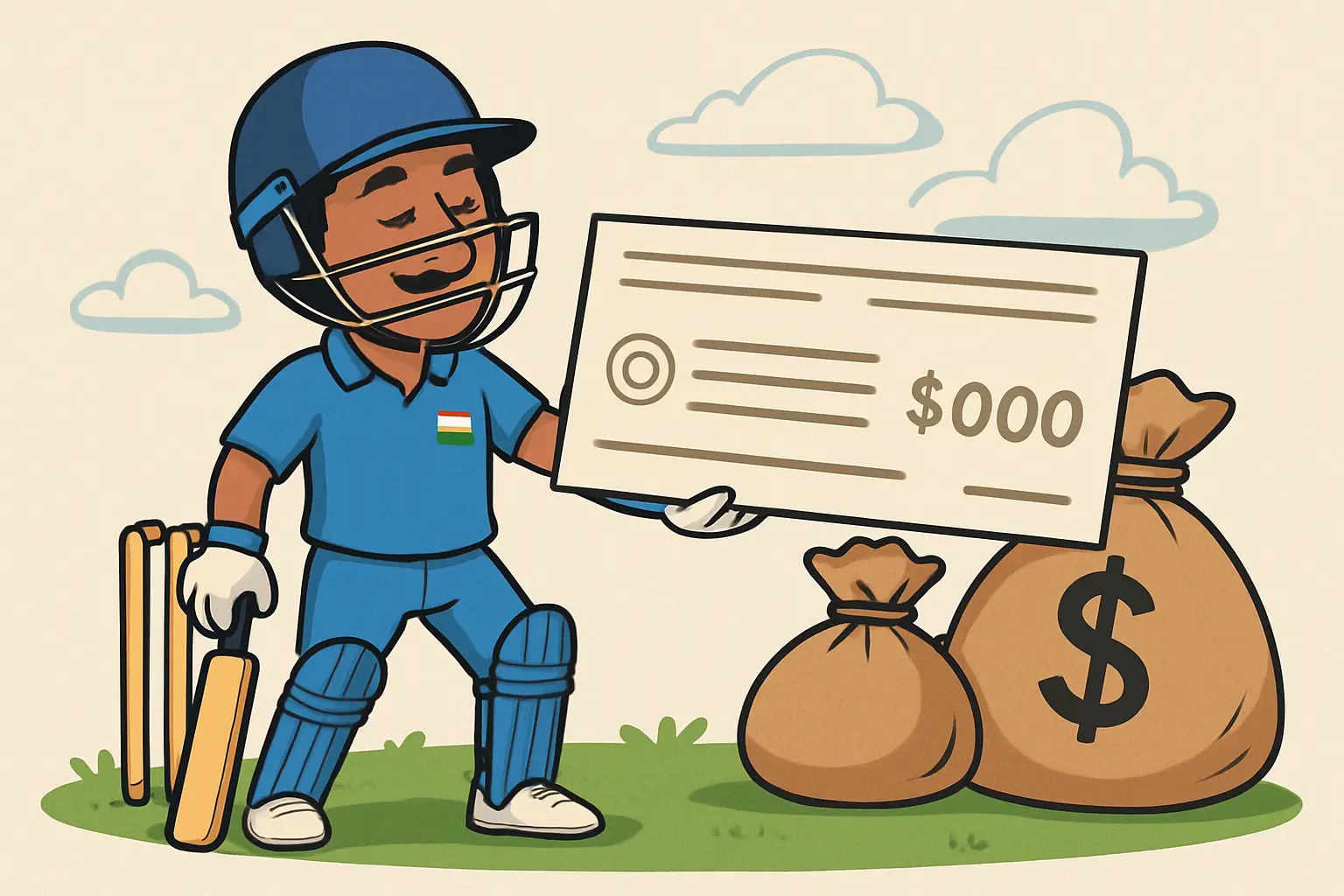
For internationals under the latest BCCI structure, the india cricketer per match fee is:
- Test: INR 15,00,000
- ODI: INR 6,00,000
- T20I: INR 3,00,000
These match fees are paid to the playing XI. Squad members who do not take the field receive tour per diem and allowances, not the match fee. Performance bonuses and awards are extra.
India international match fee (men and women)
| Format | Match fee (INR) |
|---|---|
| Test | 15,00,000 |
| ODI | 6,00,000 |
| T20I | 3,00,000 |
BCCI central contracts: grades, retainers, and what they really signal
A BCCI central contract is the backbone of india cricketer salary. The retainer secures a player’s services to Indian cricket and underpins annual earnings; match fees and bonuses stack on top.
Current BCCI men’s central contract retainers
| Grade | Annual retainer (INR) |
|---|---|
| A+ | 7,00,00,000 |
| A | 5,00,00,000 |
| B | 3,00,00,000 |
| C | 1,00,00,000 |
What each grade typically represents
- Grade A+: Reserved for mainstays across formats—the players who carry heavy workloads in Tests, ODIs, and T20Is. It’s not a lifetime badge; it reflects current reality. When a bowler becomes the first name on the team sheet in all three formats, this is where he lands.
- Grade A: Elite first-team players who are indispensable in two or three formats, or absolute match-winners in one format and regulars in another.
- Grade B: Solid first-teamers or frequent squad players who contribute consistently across one or two formats.
- Grade C: Players on the fringe of the first-choice XI or specialists who appear less frequently but remain in national plans.
How BCCI contracts work in practice
- Cycle and renewal: Contracts run in cycles and are reassessed after each cycle. Selections, performances, fitness, role clarity, and team balance factor into renewals and upgrades or downgrades.
- Fitness criteria: Yo-Yo and DEXA benchmarks are part of the ecosystem. In plain terms, if you want a higher grade, you must show up fit, pass mandatory tests, and sustain that standard. The board has also signalled that availability for domestic cricket during non-international windows matters.
- Injury and rehab: The retainer holds even if a player is injured. Match fees are naturally tied to appearances, but NCA-led rehab, travel, and medical costs are covered. There’s protection built in so injuries don’t crater a player’s livelihood.
- Selection independence: Contracts don’t guarantee selection. Selection doesn’t guarantee an upgrade. The two conversations inform each other, but they’re not identical.
BCCI women’s central contracts and pay equality on match fees
Women’s cricket has two pillars: a graded BCCI retainer and equal international match fees. The second part is the landmark—on match days, a woman in blue earns the same per game as a man.
Women’s BCCI retainer (annual)
| Grade | Annual retainer (INR) |
|---|---|
| A | 50,00,000 |
| B | 30,00,000 |
| C | 10,00,000 |
Match fee parity (women)
| Format | Match fee (INR) |
|---|---|
| Test | 15,00,000 |
| ODI | 6,00,000 |
| T20I | 3,00,000 |
That parity is more than symbolism. In seasons stacked with white‑ball internationals, match fees can exceed the women’s retainer, pushing top performers well past a crore solely from BCCI pay.
Retainer vs match fee vs bonus: what each line item means
- Retainer: Your guaranteed annual amount tied to your contract grade. It’s paid in instalments and taxed at source.
- Match fee: Paid per international appearance in the playing XI. Separate from the retainer, again taxed at source.
- Bonuses and awards:
- Series/tournament bonuses: The board sometimes announces additional payouts for major series wins or ICC event performances. These are discretionary and vary.
- Player-of-the-match/series awards: Sponsored awards presented post-game. Amounts vary by series and host board arrangements.
- ICC prize pools: When India earns prize money at ICC events, the board may allocate a share to players. It is not a fixed percentage codified in public documents; it’s communicated at the time.
Do non-playing squad members receive match fees?
For internationals, only the playing XI earn the match fee. Squad members who remain unused on the day receive tour per diems and allowances. In special cases governed by the playing conditions—such as concussion substitutes—the replacement who officially enters the game is treated as part of the XI for payment purposes, and the board ensures the replaced player is not penalized for a medical event. The administrative mechanics are handled internally; the principle is that nobody loses money due to injury protocols.
India domestic salaries: Ranji, Vijay Hazare, Syed Mushtaq Ali
If international cricket is the shop window, domestic cricket is the factory floor. BCCI raised domestic compensation with a structure that rewards experience and format.
Senior men’s domestic match fees (BCCI scale)
| Competition | Experience slab | Match fee |
|---|---|---|
| Ranji Trophy (per playing day) | Fewer than 20 first-class matches | 40,000 |
| 21–40 first-class matches | 50,000 | |
| More than 40 first-class matches | 60,000 | |
| Vijay Hazare Trophy (per match) | Fewer than 20 List A matches | 20,000 |
| 21–40 List A matches | 25,000 | |
| More than 40 List A matches | 30,000 | |
| Syed Mushtaq Ali T20 (per match) | Fewer than 20 T20 matches | 10,000 |
| 21–40 T20 matches | 15,000 | |
| More than 40 T20 matches | 20,000 |
How to read those numbers in real life
- Ranji days are paid per day, not per match. A four‑day league game equals four daily fees; a five‑day knockout equals five.
- The experience slab uses official appearances in that format class (first‑class/List A/T20).
- Daily allowance, travel, and accommodation are covered. Players receive a per diem (a few thousand rupees per day), fly to venues, and stay in board‑approved hotels. State associations co‑ordinate logistics; BCCI underwrites the scale.
Domestic women and age‑group cricketers
Senior women receive BCCI‑set match fees with their own slabs and a per diem. The absolute numbers are lower than the men’s domestic scale but were revised upward alongside broader reforms.
Under‑19 and Under‑23 structures mirror senior frameworks with reduced slabs, ensuring meaningful compensation for the pathway.
State association retainers
Several major associations offer annual state contracts to a core group of men’s and women’s players. These are retainer‑style monthly payments on top of BCCI match fees, designed to stop the income roller coaster for players who may have lean months. The amount varies widely by association—richer states put more into the pot—and the coverage can be twenty to forty players per team. For journeymen pros who may miss an IPL deal, these state retainers are the difference between living comfortably and hustling in the off‑season.
India A and tour matches
India A fixtures are the finishing school. The pay mirrors senior domestic rates for the match class (first‑class/List A/T20), topped up by an international‑grade per diem and full travel and medical coverage. It’s not headline money, but the exposure and continuity lead directly into central contracts and IPL auctions.
WPL vs BCCI women’s salary: how the two streams meet
The Women’s Premier League reshaped women’s earnings in a way even veterans didn’t see coming. Top WPL retainers can exceed BCCI Grade A by a broad margin in one auction. Blend that with equal match fees for internationals and a full India calendar, and you get a sustainable income that was unimaginable not long ago.
A typical season for a top India women’s player might look like:
- BCCI retainer (Grade A): INR 50,00,000
- International match fees (mix of formats): anywhere from INR 30,00,000 to above INR 1,00,00,000 depending on fixtures
- WPL contract: auction dependent; top deals can leap past INR 3,00,00,000
- Endorsements: individual, rising sharply in metropolitan markets
- Occasional bonuses/awards: variable
The precise tally swings with fixtures and the WPL number, but the floor is now professional and the ceiling climbs every cycle.
IPL vs BCCI salary for men
Ask any agent and they’ll tell you: ipl salary vs bcci salary is the most common comparison players—and families—make. Here’s the grounded take.
- BCCI retainer and match fees are real money. An A+ male player who plays a healthy international calendar can clear INR 9–10 crore from BCCI alone before endorsements and bonuses.
- The IPL can dwarf that for certain profiles. A mid‑career white‑ball specialist with a high auction value can earn an IPL salary that exceeds the BCCI retainer multiple times, even if he is Grade B or Grade C.
- On the flip side, a Test‑heavy workload tilts income toward BCCI. If you play most of India’s Tests and are centrally contracted at a high grade, BCCI may pay you more than your IPL franchise, especially if your auction value is moderate.
- The healthiest financial outcome is balance: high BCCI grade + full match calendar + a solid IPL deal + at least two marquee endorsements.
Player-specific salary snapshots (illustrative)
Virat Kohli BCCI salary
- Contract grade: Typically among the top grades owing to multi‑format pedigree and seniority.
- BCCI income: A+ retainer plus match fees across formats. Kohli’s India appearances add substantial match‑fee earnings to the retainer.
- Outside BCCI: Significant endorsements and an IPL contract that ranks among top franchise deals. For brand‑related income, he sits in a class of his own.
Rohit Sharma BCCI salary
- Contract grade: Among the top bracket, anchored by captaincy responsibility and all‑format presence.
- BCCI income: Retainer plus match fees that swell in Test stretches. Prestigious awards and series bonuses have dotted the arc of his captaincy.
- Outside BCCI: Strong IPL deal; long‑standing endorsements.
Jasprit Bumrah BCCI salary
- Contract grade: Top bracket due to all‑format value and workload management complexity.
- BCCI income: Retainer + per‑match fees paced around medically engineered workloads. When fit, Bumrah’s presence in all formats drives heavy match‑fee accumulation.
- Outside BCCI: Major IPL deal and premium endorsements aligned to performance metrics.
Rishabh Pant salary BCCI
- Contract grade: High tier reflecting his role as a match‑defining wicketkeeper‑batter.
- BCCI income: Retainer and match fees vary by comeback arcs and formats played in a season.
- Outside BCCI: Strong IPL contract; rising commercial profile.
Shubman Gill salary BCCI
- Contract grade: Rising through the grades in line with elevated all‑format responsibility.
- BCCI income: Retainer + match fees across formats when selected. Young, all‑format batters rack up appearances fast.
- Outside BCCI: Prominent IPL contract and rapidly scaling endorsements.
Suryakumar Yadav salary BCCI
- Contract grade: White‑ball centrepiece.
- BCCI income: Retainer + T20I and ODI fees; Test appearances add spikes when they happen.
- Outside BCCI: Stout IPL salary and a creative endorsement portfolio.
MS Dhoni BCCI salary (history)
- Contract grade: Before stepping back from internationals, Dhoni inhabited the upper grades. When A+ arrived, he was no longer all‑format, so his retainer aligned with that reality.
- BCCI income then: High retainer + match fees across the formats he played.
- Now: IPL iconography. His legacy with BCCI pay sits in the blueprint of how wicketkeeper‑captains were valued.
Highest paid Indian cricketer
In any given cycle, the answer is a triangle: top BCCI grade + heavy international calendar + a large IPL contract. Factor in endorsements and the leaderboard can tilt toward the biggest brands even if another player logs more BCCI minutes. In practice, Virat Kohli, Rohit Sharma, and Jasprit Bumrah headline the annual total‑earnings conversation, with white‑ball captains and all‑format young guns in the mix.
Match fee vs retainer: how to think about the split
- Retainer is the floor. It rewards trust, perceived value, and expected availability. It doesn’t fluctuate with form inside a cycle.
- Match fee is the accelerator. The more you play, the more you earn, simple as that. For players on the cusp of grades, a full tour in the XI can rival a grade jump’s value.
- A Test‑heavy lineup swells match‑fee earnings. A white‑ball‑only season strains the equation unless you play almost every ODI/T20I.
The Test premium and incentives
The Test match fee is the largest per‑game for a reason: it asks the most of a body and a technique. In recent cycles, the BCCI has reinforced the Test premium with additional incentives targeted at those who commit to red‑ball windows, signaling that long‑form cricket remains the pole star in valuation. For regular Test contributors, this makes the per‑game earning significantly higher than white‑ball appearances.
Do warm‑ups and tour games pay match fees?
Official internationals carry match fees. Warm‑up games, intra‑squad contests, and tour fixtures against state or Board XIs are compensated via per diem and allowances, not the international match‑fee scale. Still, those games matter—coaches calibrate selections off those days, and a strong tour game can be the difference between carrying drinks and slotting into the XI.
Prize money, awards, and what gets shared
- ICC events: When India captures a major ICC cheque, the board commonly announces how the pot is distributed. Sometimes players receive a fixed share; sometimes there’s a flat bonus per player and staffer. It’s communicated in that window.
- Bilateral series: Post‑series awards include Player of the Match and Player of the Series cheques whose amounts vary by host, sponsor, and format.
- Board bonuses: For landmark wins—a long‑awaited series abroad, for instance—the board may add a discretionary bonus. It’s not contractual, but history shows it happens.
Endorsements, appearances, and net worth vs salary
For the top fifteen Indian cricketers, indian cricketer endorsement income vs salary is a real storyline. A player’s BCCI pay underpins credibility; endorsements turn fame into financial muscle. The split can be dramatic:
- Elite category: Endorsements comfortably exceed BCCI + IPL in certain stretches. Global brands, tech platforms, BFSI, and auto majors stack up.
- Strong category: BCCI + IPL still lead, with endorsements forming a solid second stream.
- Specialist category: IPL + state retainers + regional endorsements hold the portfolio together.
The lesson is not to undervalue BCCI money—it’s the foundation upon which the rest is built. When form dips or injuries intervene, the retainer remains. Endorsements ebb and flow with narrative; the BCCI contract narrates consistency.
Taxes, take‑home, and how much actually lands in the bank
Income in India is taxed progressively with surcharge and cess at higher brackets. Centrally contracted cricketers with match fees push into the top bracket, and the effective rate can move north of forty percent when surcharge applies. The mechanics:
- TDS: BCCI and state associations withhold tax at source on retainers and match fees. Players receive Form 16/16A for filings.
- Business vs professional income: Endorsements, appearances, and image rights typically fall under business/professional heads. Many players route this through personal entities for accounting clarity and expense deduction.
- Goods and Services Tax (GST): Applicable to certain brand services. Players work with CAs to manage invoicing, input credits, and compliance.
- NRI days and DTAAs: On foreign tours, day counts and treaty provisions can affect taxation on appearance fees from overseas matches. Teams and agents track this carefully; mishandling residency rules can be costly.
As a crude illustration for a men’s international in Grade A:
- Retainer: INR 5,00,00,000
- Matches: 7 Tests (1,05,00,000) + 12 ODIs (72,00,000) + 15 T20Is (45,00,000) = INR 2,22,00,000
- Gross BCCI: INR 7,22,00,000
- After top‑bracket taxes and surcharge, the net may land in the vicinity of INR 4,00,00,000–4,50,00,000, depending on deductions, state of residence, and other income.
Monthly view: indian cricketer salary per month
Retainers convert easily to a monthly lens:
- Grade A+: roughly INR 58–59 lakh per month
- Grade A: roughly INR 41–42 lakh per month
- Grade B: roughly INR 25 lakh per month
- Grade C: roughly INR 8–9 lakh per month
Remember, match fees drop in as lump sums upon settlement after each series. A month with five internationals will look very different from a month in training or rehab.
Calculator: estimate your annual BCCI earnings
Here’s a simple way to estimate:
- Pick your grade retainer.
- Add Test fees: number of Tests x 15,00,000.
- Add ODI fees: number of ODIs x 6,00,000.
- Add T20I fees: number of T20Is x 3,00,000.
- Add any known bonuses/awards.
- Apply your estimated tax rate to approach take‑home.
Example A (all‑format star, Grade A+)
- Retainer: 7,00,00,000
- Tests: 10 x 15,00,000 = 1,50,00,000
- ODIs: 6 x 6,00,000 = 36,00,000
- T20Is: 8 x 3,00,000 = 24,00,000
- Gross BCCI: INR 9,10,00,000 before bonuses and awards
Example B (white‑ball mainstay, Grade B)
- Retainer: 3,00,00,000
- Tests: 0
- ODIs: 12 x 6,00,000 = 72,00,000
- T20Is: 18 x 3,00,000 = 54,00,000
- Gross BCCI: INR 4,26,00,000
Example C (fringe player, Grade C)
- Retainer: 1,00,00,000
- Tests: 0
- ODIs: 3 x 6,00,000 = 18,00,000
- T20Is: 5 x 3,00,000 = 15,00,000
- Gross BCCI: INR 1,33,00,000
Domestic pro’s season (senior men, experienced)
- Ranji group: 8 matches x 4 days x 60,000 = INR 19,20,000
- Vijay Hazare: 8 matches x 30,000 = INR 2,40,000
- Syed Mushtaq Ali: 10 matches x 20,000 = INR 2,00,000
- Gross domestic: INR 23,60,000 plus per diems and travel. Add a state retainer if available.
Fitness, availability, and the fine print that matters
- Mandatory fitness metrics: The Yo‑Yo and DEXA checkpoints aren’t optional. A player who treats them as mere hurdles quickly learns they are gates to grade stability. Fail repeatedly, and you feel it in your contract talk.
- Domestic duty: Centrally contracted players are expected to play domestic cricket when not on India duty or in rehab. This protects the domestic product and tests temperament. Skipping without sanctioned reasons can influence renewals.
- Fast‑bowling management: Pacers are placed on individualized workloads. The board has been exploring special contracts and support frameworks for a broader pool of quicks so that India isn’t short of high‑pace options. The pay element is evolving, but the intent is clear—value the attrition of fast bowling.
Injury compensation, insurance, and pensions
- Injury coverage: Medical treatment, surgery, rehab stints at the NCA, and return‑to‑play protocols are board‑funded for contracted players. Short‑term pain shouldn’t become long‑term debt.
- Insurance: Touring squads are covered by comprehensive travel and health policies. Equipment insurances are commonplace among professionals, particularly bat sponsorships with coverage for breakage.
- Pensions: BCCI runs a pension program for retired internationals, first‑class cricketers, umpires, and scorers. The slabs were enhanced in recent reforms, raising the monthly support. For many former players who missed the boom years of leagues and big retainers, this is not charity—it is overdue recognition.
Do unused squad players get paid in India cricket?
Short form: Not the match fee. They get per diems, accommodation, and full travel coverage. Over a long tour, that per diem adds up, but it’s not the same as playing. This is how the system incentivizes breaking into the XI and staying there.
Do warm‑up games pay match fees in India?
No match fee in the international sense. Tour games and intra‑squad fixtures are compensated through allowances. They do, however, decide careers in the margins. Ask any batter who peeled off a hundred in a quiet weekday game in Alur and then found his name on the team sheet in the next Test.
When are BCCI contracts announced and how often revised?
The central contracts align with the board’s cycle. Reviews follow the close of that cycle, and the new list lands after selection and administration clearances. Compensation scales—retainer amounts and match fees—are revisited periodically, not haphazardly. Big shifts tend to come with strategic decisions: recognizing all‑format elites, protecting Test cricket, or aligning women’s pay with a new commercial reality.
What benefits do Indian cricketers get besides salary?
- Structured calendars, world‑class support staff, NCA access
- Business‑class travel for senior internationals and premium team hotels
- Daily allowances, tour insurance, visa handling, logistics support
- Kit, equipment support, and bat/gear sponsorship facilitation
- Match‑day bonuses and award platforms
- Post‑career pathways via coaching badges, zonal academies, commentary, and administration roles
- Pensions for retired players and welfare mechanisms for hardship cases
India vs Australia or Pakistan: salary perspective
- India vs Australia cricketer salary: Cricket Australia runs a revenue‑share model with a list of centrally contracted men and women, match fees in AUD, and ICC event pools. Top Australian retainers can rival Indian retainers after conversion, but IPL earnings often tilt the total‑income balance towards Indian stars.
- India vs Pakistan cricketer salary: PCB contracts have restructured slabs and improved match‑fee parity. Currency strength, series volume, and league ecosystems shape the comparison. India’s IPL and commercial pull produce larger endorsement and franchise outcomes on average.
Top 10 highest paid Indian cricketers: how the list forms
Any list that tries to rank the top ten by income needs to splice four lines: BCCI retainer, BCCI match fees, IPL salary, and endorsements. The stable core often features Virat Kohli, Rohit Sharma, Jasprit Bumrah, Hardik Pandya, KL Rahul, Ravindra Jadeja, Rishabh Pant, Suryakumar Yadav, Shubman Gill, and a floating slot for whoever is peaking in the IPL and white‑ball internationals. The order moves with auction results and commercial cycles.
Central contracts and the women’s game: equality on match day, growth through the league
Two developments define the era:
- Equal match fees for internationals: A statement turned into a pay slip. A T20I for India is worth the same for a woman as for a man.
- The WPL: A domestic league that rewards skill and star power at commercial rates. It creates a second salary spine next to BCCI contracts, grants leverage in endorsement rooms, and gives state associations a new target for talent pathways.
Domestic cricket’s quiet middle class—and why it matters
Every time I’m asked about indian cricket player salary, I steer the conversation to the domestic core. The player who logs eight Ranji matches in steamy outgrounds, bolts to white‑ball squads, and returns in time for knockouts is a professional in every sense. With BCCI’s revised match‑fee slabs and state retainers, that player can fund a year, afford the right nutrition and coaching, and take fewer off‑season risks. The pathway is viable not just for prodigies, but for disciplined thirty‑somethings who win titles for their states and keep India A humming.
Reserve players, concussion subs, and the grey zones of pay
One reality rarely discussed: grey zones are handled quietly and fairly. If a batter is subbed out under concussion laws, the team manager, the board rep, and accounting settle the match‑fee question in line with playing conditions and welfare principles. You won’t see a press note for it; you will see players returning from injuries feeling looked after.
Practical examples: three seasons, three outcomes
The all‑format warhorse
- Contract: A+ retainer
- Matches: 10 Tests, 10 ODIs, 12 T20Is
- BCCI earnings: Retainer 7 crore + match fees 1.5 + 0.6 + 0.36 = roughly 9.46 crore, plus awards and potential series bonuses
- IPL: Solid franchise deal
- Endorsements: Premium tier
- Outcome: BCCI remains a major—sometimes the largest—slice of annual income, especially in Test‑heavy windows
The white‑ball blade
- Contract: B retainer
- Matches: 3 ODIs, 20 T20Is
- BCCI earnings: 3 crore + 0.18 + 0.60 = 3.78 crore
- IPL: Star contract possibly exceeding BCCI income
- Endorsements: Good, format‑specific
- Outcome: IPL and brands lead; BCCI sets the floor
The domestic champion
- Contract: None or C grade
- Domestic: High experience slab; full Ranji + white‑ball season
- Earnings: Mid‑20 lakhs from match fees + state retainer + per diems
- IPL: If undrafted, play local leagues and camps; if drafted, year transforms instantly
- Outcome: A stable professional life through BCCI’s domestic structure; upside via leagues
Women’s cricket: a new normal in numbers
Take a top India women’s player:
- BCCI retainer: Grade A (50 lakh)
- International match fees: Suppose 1 Test, 8 ODIs, 12 T20Is then the match‑fee line alone approaches 1.05 crore
- WPL: If contracted in the top band, that can leap to 3 crore or more
- Endorsements: Growing sector, from fitness and fashion to fintech
- Outcome: A two‑spine salary world where match‑fee parity and a domestic league combine to create true professional security
Frequently asked questions (clear, concise, and current)
What is A+ grade salary in BCCI?
INR 7 crore annually as the retainer for men in the top grade, plus match fees and bonuses.
How much do Indian cricketers earn per match?
Test 15 lakh, ODI 6 lakh, T20I 3 lakh per appearance in the playing XI. The same applies to women.
Are central contracts different from IPL salaries?
Completely separate. BCCI central contracts and international match fees are paid by the board. IPL salaries are paid by franchises for the league window.
Do unused squad players get paid in India cricket?
They do not receive the international match fee. They receive tour per diem, accommodation, travel, and support.
Do warm‑up games pay match fees in India?
No. They are compensated via allowances, not international match‑fee scales.
How often are BCCI salaries revised?
The board reviews retainers and match fees periodically. Revisions coincide with strategic priorities and financial outlooks.
What benefits do Indian cricketers get besides salary?
Fitness and medical support, NCA access, travel and accommodation, daily allowances, insurance, pensions, and professional development pathways.
How do taxes impact take‑home?
Most internationals fall in the top tax bracket with surcharge and cess. Effective rates can sit above forty percent. TDS applies; endorsements and professional receipts have their own tax treatment.
Prize money share for India cricket team—how does it work?
For ICC and landmark wins, the board announces bonuses or prize‑money allocations. There’s no one fixed percentage disclosed as a standing rule.
Ranji Trophy player salary—how much can a season pay?
At the top experience slab, a full Ranji league run alone can approach two million rupees in match‑day fees. Add white‑ball events, per diems, and a state retainer and you have a legitimate professional income.
Women’s cricket pay equality in India—is it complete?
On international match fees, yes: full parity with men. Retainers still reflect different commercial baselines, but the WPL has narrowed the overall gap dramatically at the top tier.
India A player salary—what’s the framework?
Match fees track the class of cricket (first‑class/List A/T20) similar to domestic rates, with per diems and full travel coverage.
U19 India cricket salary—how are youngsters paid?
Age‑group teams operate with BCCI‑set match fees and per diems appropriate to their category, rewarding appearances and professionalism early.
Inside the room: what actually drives grade decisions
You learn a few truths listening to selection and contract meetings, often past midnight with coffee gone cold:
- Availability is a currency. The board rewards players who turn up fit across windows, not just peaks.
- Tests matter. The room lights up for a player who takes on the new ball in a swinging morning or bats through a snarling final session. That shows up in the salary policy.
- Role balance is deliberate. You can be an elite T20 batter and still land in Grade B or C if your availability is limited or if there’s a structural preference for red‑ball stability.
- Communication is better than it used to be. Players understand why they’re graded where they are, and what it would take to move up.
State associations: the quiet benefactors
The growth of state retainers is an under‑told story. In stronger associations, a senior men’s player can stack:
- State retainer
- Ranji + white‑ball match fees
- Camps and academy coaching gigs in the off‑season
For women, some associations mirror this with their own retainers and facilities partnerships. Good states invest in strength coaches, nutritionists, and analysts, translating directly into better performances and bigger BCCI cheques.
What the numbers teach us about career strategy
- Diversify formats if your body and game allow it. The Test fee is a powerful lever.
- If you’re a white‑ball specialist, own that role. Excel in roles IPL teams covet—powerplay bowling, death hitting, mystery spin—and your franchise cheque will rebalance any lower BCCI grade.
- Never neglect fitness. One missed benchmark can delay a debut or cost an upgrade.
- Treat domestic cricket like your lifeline, not an obligation. Consistency there is the only proven queue to India A and, ultimately, a central contract.
- Get a good CA early. Tax planning and compliance save more money than a mid‑tier equipment deal ever will.
India cricket salary latest: what’s changed recently
- Test cricket emphasis: The Test match fee remains the highest and the board has reinforced red‑ball value through targeted incentives.
- Women’s parity: Match‑fee equality is now embedded, and the WPL has pushed total earnings to a new plateau at the top.
- Domestic uplift: Experience‑based slabs reward longevity and keep the feeder robust.
- Fitness compliance: Yo‑Yo and DEXA are standard operating procedure again, with clear consequences for lapses.
A final word: the numbers are a mirror of priorities
Indian cricket pays for what India values. It values Tests, so the Test fee leads. It values availability, so retainers reflect it. It values growth and parity, so women earn equally on match days, and domestic pros have a path to a dignified living. The ecosystem isn’t perfect—few are—but it is coherent, and it is improving.
If you’re reading this as a fan searching for the latest bcci central contract salary or indian cricket salary per match, the big picture is simple: the BCCI retainer is your base, the match fee is your multiplier, and everything else—from prizes to endorsements—is the weather. For those who lace up and step out in blue, the salary line is proof that the system sees you, not just for a month or a marquee event, but across the long rhythm of an Indian cricket season.