

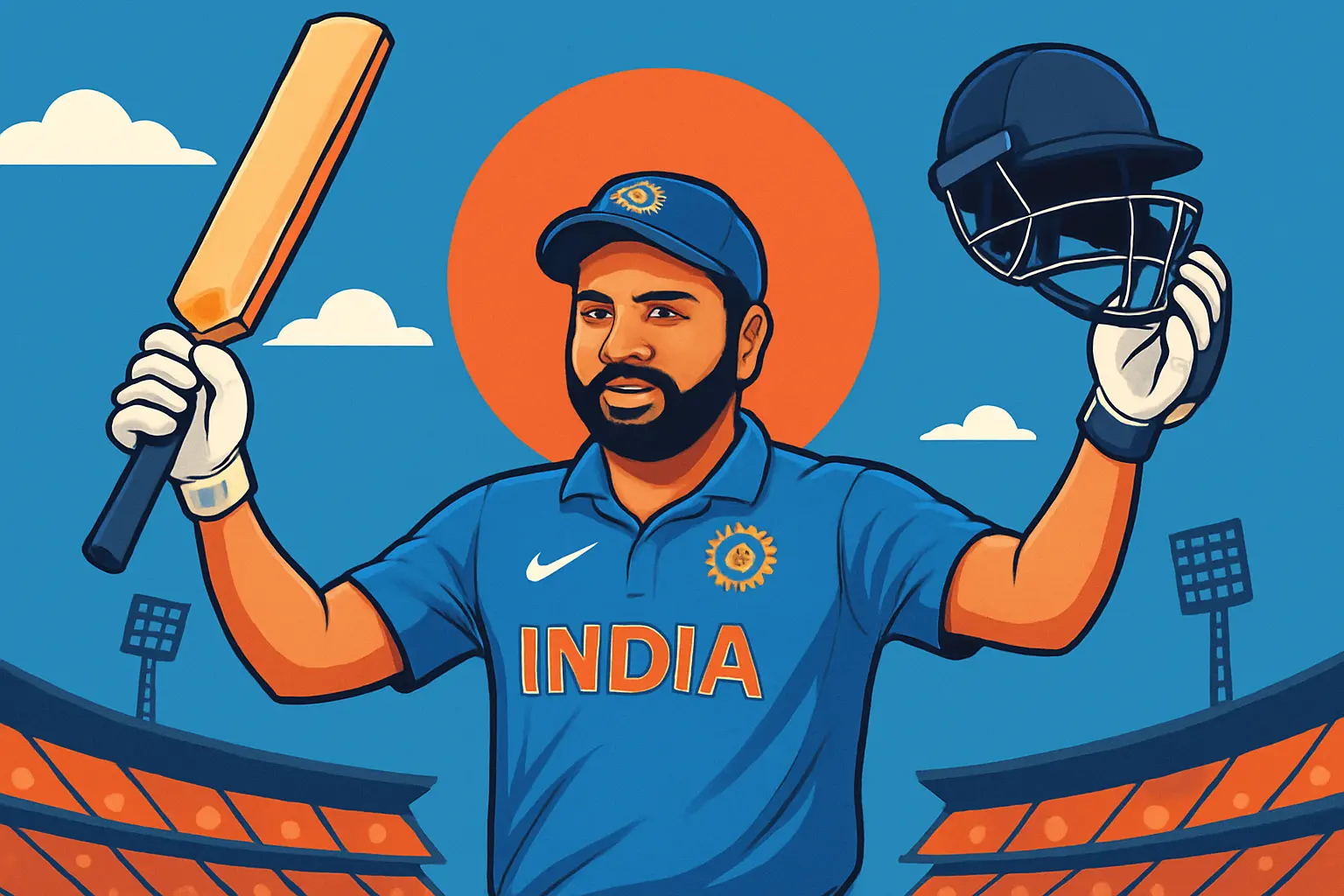
The roar begins the moment Rohit Sharma rocks back. A back‑foot punch crashes through extra cover, the bat path so late and so clean it feels inevitable. Fielders drift into the deep, captains recalculate, and a familiar rhythm takes over: Powerplay calm‑violence, middle‑overs glide, late‑overs surge. When Rohit Sharma gets to a hundred, it rarely feels like a scramble. It feels like weather settling — you could sense it ten overs earlier.
I’ve covered Rohit’s career long enough, from flights into Eden Gardens to bleary dawns at The Oval, to know that his centuries are not just numbers. They are patterns and provocations, tactical case studies and emotional landmarks, the heartbeat behind India’s modern white‑ball surge and the spine of more than one Test summer. This is the complete, expert look at the Rohit Sharma century — the technique, the tempo, the lists that matter, and the context you won’t always get on a cold stats page.
What a Rohit Sharma Century Really Looks Like
There’s a template — and then there are the deviations that make him mortal and, paradoxically, great.
- The takeoff: Most of his ODI and T20I hundreds are born in the first ten overs. He plants, holds shape, and lifts length balls over extra cover as if they’re throwdowns. The early pull to fine leg, the checked punch through mid‑off, and the dab late behind point are stress valves that build rather than burst.
- The middle overs discipline: Rohit’s century engine is built on glide. Singles to sweeper cover, twos punched past long‑on, the occasional one‑handed drag behind square. His balls per boundary often fall into a metronomic range, typically one boundary every 8–12 balls in ODIs when he’s on his way to a big one.
- The powerplay contradiction: He can score at T20I powerplay pace in ODIs while looking sedate — swing reading, late opening of the face, anticipation of short balls vs full deliveries.
- Test recalibration: As a Test opener, the blueprint shifts: deeper base, later play, sudden brutal pulls, and loft into cover when conditions allow. On turning surfaces, sweep and slog‑sweep break lengths; on greeners, patience rules.
- The finishing kick: Often the last 20 runs come quickly. He tightens angles, picks on weaker seamers, and goes flat over extra, mid‑wicket, or mid‑on. A hundred turns into 135 rapidly.
Quick‑Answer Box: Rohit Sharma Century Totals and Flagship Records
Rohit Sharma Centuries: Records at a Glance
| Category | Record / Stat |
|---|---|
| International centuries (ODI/Test/T20I) | 48 (31 / 12 / 5) |
| ODI World Cup centuries | 7 (record) |
| Most hundreds in a single ODI World Cup | 5 (record) |
| ODI double hundreds | 3 (record) |
| Highest ODI score | 264 vs Sri Lanka, Kolkata |
| Highest Test score | 212 vs South Africa, Ranchi |
| Highest T20I score | 121* vs Afghanistan |
| Fastest T20I hundred | 35 balls vs Sri Lanka |
| IPL centuries | 2 (MI: 2) |
Note: Counts reflect the latest widely reported tallies and will continue to evolve.
Format‑Wise Deep Dive: How Rohit Builds Hundreds
Rohit Sharma ODI Centuries — The Powerplay Gambit That Turns Into Avalanche
In ODIs, Rohit’s hundreds are a thesis on modern opening. He is both conservative and attacking in the first five overs — the contradiction is the feature, not the bug. When swing is present, you’ll see the soft hands and drop‑and‑run singles. When it isn’t, he launches.
He often gets to 30 off 35 without looking hurried; that’s when captains misread the tempo. Once the ball softens, he wins the middle overs by refusing to let bowlers own length. Watch his strike rotation to mid‑wicket — it’s premeditated. That’s why his big ODI hundreds tend to include a section between 50 and 90 where you barely remember a false stroke.
Iconic ODI Hundreds and Why They Mattered
- 264 vs Sri Lanka, Kolkata: The Everest of ODI batting — set the ceiling.
- 209 vs Australia, Bengaluru: The origin myth of the Rohit double.
- 208* vs Sri Lanka, Mohali: Complete of wristwork, patience and acceleration.
- 171* vs Australia, Perth: Bounce negotiated, square boundaries mined.
- 141* vs Australia, Jaipur: A chase that re‑wrote belief against quality pace.
- 140 vs Pakistan, Manchester (World Cup): Big‑match temperament; plan executed.
- 137 vs Bangladesh, Melbourne (World Cup knockout): Knockout clarity and control.
Rohit Sharma Test Centuries — From Middle‑Order Talent to Elite Opener
The Test story has two acts. Early runs in flourishes and later, a complete pivot as an opener. Opening the batting, he learned to make the new ball behave: compact back‑and‑across, patient leave, and shot selection focused on high‑value percentages.
Notable Test Hundreds with Context
- Century at The Oval vs England: First outside Asia; command over short‑of‑a‑length deliveries.
- Double hundred vs South Africa, Ranchi: Once he beds in against spin, he expands across the V.
- Ton at Chepauk vs England: Lofted sweeps and inside‑out drives on a turning pitch.
- New‑ball masterclass vs Australia at Nagpur: Patient leaves and sudden pulls defined the inning.
Rohit Sharma T20I Century Profile — Precision Violence
A Rohit T20I hundred isn’t a slogathon. It’s geometry. His base remains still; his hands do the work. Flat sixes over extra cover, reactive pulls off back‑of‑a‑length and a finishing kick across 14–20 overs are the motifs.
- 118 vs Sri Lanka, Indore: 35‑ball hundred — laboratory‑grade bat path.
- 100* vs England, Bristol: Chase control; allowed pitch to come to him, then pulled decisively.
- 121* vs Afghanistan: Highest T20I score — straight hitting penalised bowling plans.
Rohit Sharma IPL Centuries — Franchise Roles, Same Aura
In the IPL he’s been anchor, aggressor, and tactical decoy. His centuries force early field adjustments and leave captains out of ideas by the tenth over.
- 109* at Eden Gardens vs KKR: Loft and late cuts that stretch the ground.
- 105* at Wankhede vs CSK: Captain’s hundred — used short straight boundaries cleverly and rode bounce.
Format Summary: Centuries, Peaks, and Signatures
| Format | Centuries | Highest Score | Double Hundreds | Fastest 100 (known) |
|---|---|---|---|---|
| ODI | 31 | 264 | 3 | Sub‑70 balls range (typical in dominant powerplays) |
| Test | 12 | 212 | 1 | N/A (tempo via phases) |
| T20I | 5 | 121* | — | 35 balls (joint Indian record) |
| IPL | 2 | 109* | — | Powerplay impetus, back‑end surge |
Why Rohit’s Century Conversion Improved After Opening
- Vision of swing and bounce: As opener he sees more new balls and picks lengths earlier while keeping late bat decisions.
- Field power: Powerplay restrictions expose square boundaries that Rohit punishes with pull and inside‑out over extra.
- Mental tempo: He choreographs an innings instead of reacting; boring, long stretches are the plan.
The Tactical DNA of a Rohit Hundred: Ball‑by‑Ball
- Balls 1–12: Risk audit — leaves, dabs, and one authoritative stroke to establish range.
- Balls 13–36: Boundary mapping — finds gaps and forces the bowling captain to burn plans.
- Balls 37–70: The blanket — seamers pulled flat, spinners attacked, singles flow.
- Balls 71–100: Lift‑off — strikes spike, century arrives, field looks wrong.
Rohit Sharma World Cup Centuries — Big Tournaments, Bigger Temperament
World Cups sharpen his decision‑making and simplify his method. The five‑hundred edition was not just volume — it was adaptability across conditions and sustained middle‑over dominance.
- The five‑hundred edition: Volume and versatility across Asia, Oceania and England.
- The record tally: Seven ODI World Cup hundreds across varied venues.
- Key examples: Pakistan (Manchester), Bangladesh (Melbourne knockouts) — measured, ruthless, and contextually mature innings.
Opponent‑Specific Insights
Against Australia
Bounce merchants meet a pull‑shot professor. Rohit waits for chest‑high balls and rolls wrists late to keep them in front of square. The 209 at Bengaluru and 171* at Perth are highlight reels.
Against Pakistan
He simplifies: fewer risks outside off, earlier triggers for the pull, heavy use of mid‑wicket to long‑on to unsettle lines (World Cup Manchester 140 is an example).
Against England
Patience plus sudden violence. The Oval ton combined leave‑discipline with short‑ball attacks and inside‑out solutions in white ball games.
Against South Africa
Hard lengths bring Rohit’s compact back‑foot game to the fore — ruthless use of horizontal bat shots in Tests; in ODIs he forces good lengths fuller.
Other opponents (NZ, SL, BD, WI, AFG, NED)
Each opponent highlights a facet: NZ demands later play, SL suits square arcs, BD requires early rotation and late elevation, AFG invites elevation once pace is judged.
Venue‑Wise Centuries: Where the Bat Sings Loudest
Wankhede
Home ground control — still head, true bounce, short straight reward. IPL and international tons show similar signatures.
Eden Gardens
Theatre. The 264 sits in lore; Eden knocks expose Rohit’s dominance square of the wicket under lights.
Narendra Modi Stadium & Chinnaswamy
Big grounds where straighter hitting and pull‑power win; hundreds here showcase bat speed and timing.
MCG / SCG / Lord’s / The Oval
Big‑ground bounce (MCG, SCG) suits acceleration; Lord’s and The Oval test technique and patience. His outside‑Asia hundreds are landmark statements.
Dubai / Colombo / Pallekele
Neutral tournament sites and Sri Lankan venues highlight his adaptability: sweep, loft and late bat face manipulations depending on dew and grip.
Situation and Record Angles
Fastest Century
T20I: 35 balls (joint Indian best). ODI fastest hundreds typically sit sub‑70 balls when the powerplay is dominant.
First / Maiden Centuries
ODI maiden came after he owned the opener’s role; Test maiden included twin centuries on debut; IPL maiden at Eden Gardens is noted for tempo setting.
Centuries as Captain / As Opener
Multiple international hundreds as captain; as opener his conversion and tempo control improved dramatically.
Centuries in Chases / Knockouts
Examples: Jaipur 141* (chase), Bristol 100* (T20I chase), Melbourne 137 (World Cup knockout) — patterns of calm‑control and late surges.
Rohit Sharma Double Hundreds & 264 Highlights
Three ODI double hundreds — a record. Each double tells a different story: late‑overs carnage, masterful rotation or relentless angle work.
Comparisons Without Tired Debates
Short summaries: Virat’s relentlessness vs Rohit’s expansion; Sachin’s template vs Rohit’s ceiling‑redefinition; comparisons to Warner and Babar lean on tempo and aggression, but Rohit’s late acceleration into the 90s is distinctive.
Phase‑Wise Scoring and Hidden Metrics
- Powerplay strike rate: Healthy aggression without frantic risk — expects one boundary per over.
- Middle‑overs boundary percentage: Lower than a slogger; designed to expand later.
- Balls per boundary in ODI hundreds: 8–12, dropping to 6–8 in the final third.
- Control percentage: Home big hundreds often 85–90% control; abroad mid‑80s can still win days.
- Partnerships: Hundreds often include at least one fifty‑plus stand where Rohit scans fields and tempts captains into change.
How to Read a Live Ton in the Making
If the notification pops — ‘Rohit Sharma fifty off 44’ — look for these signs:
- Shot selection symmetry: boundaries both behind point and over mid‑wicket.
- Seamers into the wind: a big over here usually prefaces a hundred.
- Spinner under attack against the turn: sweeping against the turn and nailing it is a strong signal.
- Body language: exaggerated leaves and baiting drives outside off.
Match Coverage Essentials for the Latest Rohit Sharma Century
Score summary to track: 10‑over score, boundary count, balls per boundary, dots in last five overs before the hundred. Partnership narrative and records watch are essential.
Filterable Mini‑Blocks (Template)
Use this template in match reports; fill variables for quick, consistent framing.
Iconic Centuries: Curated Table of Ten That Tell His Story
| Opponent | Venue | Format | Score | Why It Mattered |
|---|---|---|---|---|
| Sri Lanka | Kolkata | ODI | 264 | Highest ODI score; re‑defined the ceiling. |
| Australia | Bengaluru | ODI | 209 | First double; pace‑on annihilation. |
| Sri Lanka | Mohali | ODI | 208* | Complete innings: control into carnage. |
| Australia | Perth | ODI | 171* | Bounce tamed; square dominance. |
| Australia | Jaipur | ODI | 141* (chase) | Tempo‑perfect pursuit against pace. |
| Pakistan | Manchester | ODI (WC) | 140 | Big‑match clarity and execution. |
| Bangladesh | Melbourne | ODI (WC knockout) | 137 | Knockout temperament; measured, ruthless. |
| England | The Oval | Test | 127 | First outside Asia; patience to dominance. |
| Sri Lanka | Indore | T20I | 118 | 35‑ball hundred; geometry of violence. |
| England | Bristol | T20I | 100* (chase) | Ice in a chase; control across formats. |
Frequently Needed Nuggets (Featured‑Snippet Style)
- How many centuries does Rohit Sharma have overall?
- 48 international centuries across formats, plus 2 in the IPL.
- How many ODI centuries?
- 31.
- How many Test centuries?
- 12.
- How many T20I centuries?
- 5.
- How many World Cup centuries?
- 7 in ODI World Cups — the most by any batter.
- How many double hundreds in ODIs?
- 3, the most by any player.
- What is Rohit Sharma’s highest score?
- 264 in ODIs; 212 in Tests; 121* in T20Is.
- Fastest century?
- In T20Is, 35 balls (joint Indian record).
Style Book: How Rohit Destroys Plans on the Way to 100
- Versus hard length: Hangs back, short‑arm pulls in front of square — wrist‑led angle.
- Versus full and straight: High front elbow plus late wrists produce flat sixes.
- Versus leg‑spin: Waits on length — short gets cow corner, full outside off gets inside‑out.
- Versus left‑arm orthodox: Early sweep tests line; reverse sweep or step out if corrected.
- Versus off‑spin: Opens the face and works with the spin or flat‑bat punches when it darts.
Captaincy and Centuries
As captain, Rohit’s centuries are message control — a hundred does more than score runs; it calms dressing rooms and dictates tournament narratives. Bat speed and intent while wearing the armband often translate into early dominance in matches.
Home / Away / Neutral — The Splits
Home: more hundreds and higher control percentages. Away: fewer but more significant statements (Oval, Australian venues). Neutral: tournament windows where process and adaptability are highlighted.
Data & Content Ideas for Analysts and Editors
- Filterable century table (format, opposition, venue, captaincy, strike rate, boundaries, phase splits).
- Timeline chart plotting every century with short context notes.
- Venue heatmap of boundary frequency by region (cover, mid‑wicket, straight).
- Embeddable CSV and a “Rohit hundred tracker” widget for match days.
Hindi Corner
रोहित शर्मा शतक: जब रोहित टच में आते हैं, गेंदबाजों के लिए रात लंबी हो जाती है। पावरप्ले में अंदर‑बाहर शॉट, मिड‑ओवर्स में गैप ढूँढते सिंगल‑डबल और आख़िरी ओवर्स में टॉप‑गियर — यही है रोहित के शतकों का टेम्पो। उनके नाम वनडे में तीन दोहरे शतक, वर्ल्ड कप में सबसे ज़्यादा शतक और टी20आई में 35 गेंदों का तूफ़ानी शतक जैसे बड़े रिकॉर्ड हैं।
Tournaments Focus: Champions Trophy and Knockouts
Rohit’s shorter-format tournament hundreds (Champions Trophy, World Cup knockouts) are often inevitabilities. Once fifty is reached he breaks plans quickly — the semi vs Bangladesh in a recent Champions Trophy is an example of dominance after the fifty mark.
Most Repeatable Hundred Pattern — Analyst Cheat Sheet
- First 10 overs: target ~1.2 boundaries per over; risk selective.
- Overs 11–25: boundary every ~10 balls; dot percentage under 25.
- Overs 26–40: two calculated assaults; average ~6.5 RPO.
- Overs 41–50: farm strike for finishers; loft straight if long‑on is square.
How to Out‑Serve the SERP on Rohit Centuries
Deliver unique value by adding phase‑wise scoring, a clear “what changed” moment, opposition plan autopsy and venue nuance. Link match reports to format pages like “ODI centuries” or “Test centuries outside Asia” to make evergreen content that updates as new hundreds arrive.
Form Signals (2024–2026) — How to Read Without Dates
Avoiding dates, look for three signals: uptick in powerplay boundary rate, drop in dot percentage against spin, and rise in back‑end sixes-to‑fours ratio. When those three align, centuries are more likely than forecasted.
Curated FAQ — Plain Language
- What makes a Rohit Sharma century special?
- Volume plus shape: low risk early, then sudden acceleration that creates the sense of inevitability.
- Why so many big ODI hundreds?
- Powerplay mastery, middle‑over control, and a finishing kick that punishes fifth bowlers plus a versatile shotset (pull, inside‑out, straight loft).
- Is he a better home or away centurion?
- More at home; but away hundreds often carry bigger statements.
- Can he still score T20I hundreds regularly?
- Yes — his base requires stillness not brute slog, so repeatable T20I hundreds are plausible with form.
- Single most unplayable Rohit shot on century days?
- The front‑foot pull in front of square.
Mini‑Profiles: Centuries by Type
- The accumulator’s hundred: 104 off 120 with a late sprint — practiced ODI grind.
- The destroyer’s hundred: 130 off 90 — World Cup/IPL blitz when powerplay lands.
- The sculptor’s hundred: 127 off 256 — Test slow burn on tricky pitches.
How Bowlers Have Tried to Stop the Century — And What Fails
- Short ball barrage early: He often pulls from front foot and keeps it down — can feed the shot.
- Wide full swing: Works briefly; he eventually late‑cuts or leaves and attacks elsewhere.
- Two‑paced into the pitch: Can stall him on sticky surfaces but requires perfect hip line.
- Turn away with drift: Genuine 3‑D spin can trouble him, but it must be sustained and high quality.
Live Checklist: Is a Rohit Hundred Loading?
- Controls 10 of the last 12 balls faced.
- Nails one pull and one extra‑cover loft inside the last five overs.
- Becomes selective outside off; big leaves appear.
- Teammate at the other end has struck under 80 SR for 20+ balls — acceleration likely.
Where Next? The Short Answer
White‑ball future: as captain and opener, his role is to compress the powerplay and then be anchor‑accelerator. Red‑ball future: selective formats and venues will suit him best, but when he commits to innings tempo he can still dictate terms.
Closing: Why Rohit Sharma Centuries Keep Pulling Us Back
A Rohit Sharma century isn’t only a number. It’s the sound of the game bending to a batter’s will without reckless violence. It’s a still head and late hands conjuring pace where none exists, or taming it when there’s too much. There will be sudden blinks and slow burns alike — and they will all be worth watching. When he’s in the 90s, watch with your eyes: the bat will tell you the rest.